
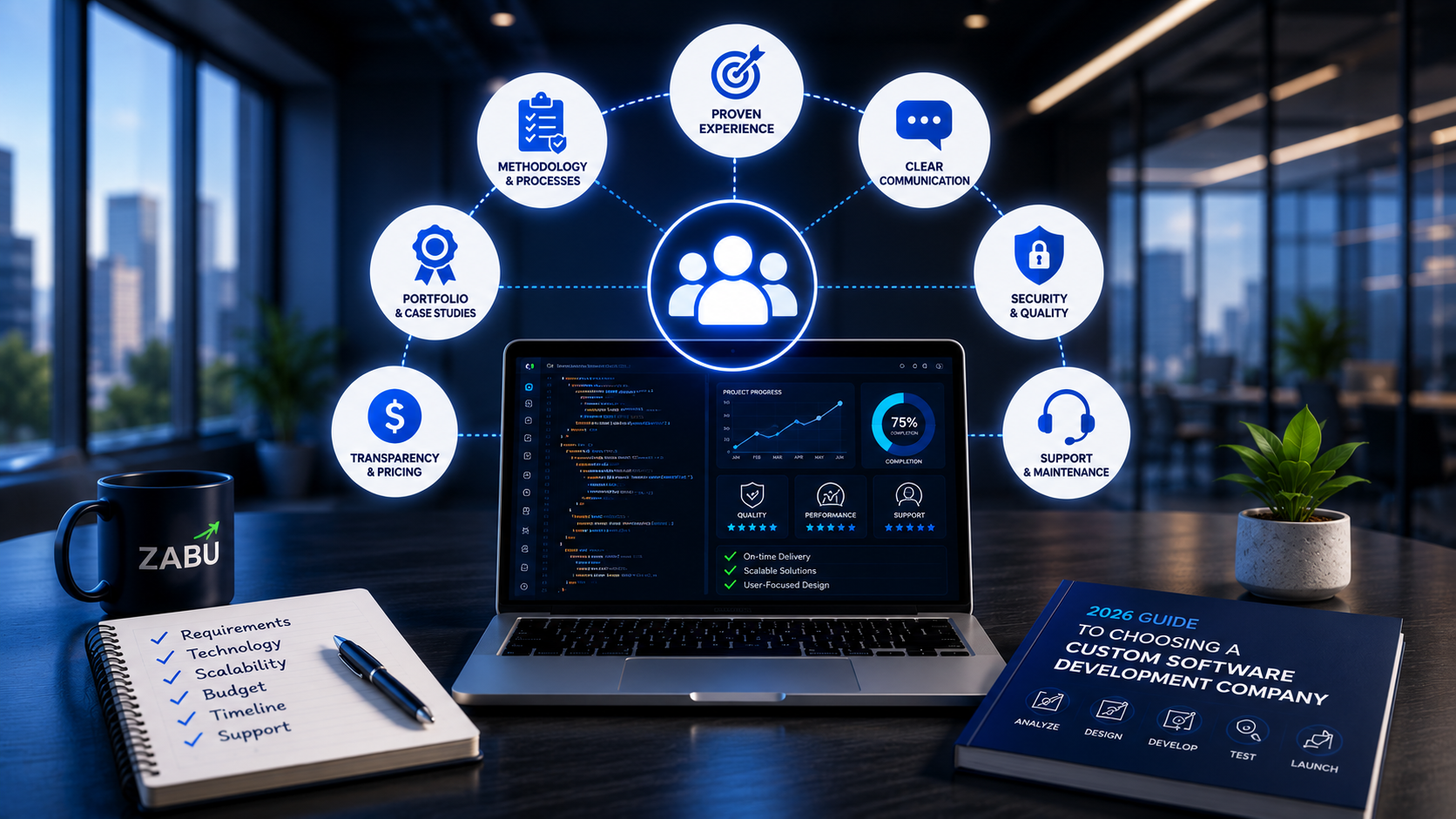
To choose a custom software development company, weigh five factors above price: real technical experience, the ability to understand your business, working style and communication, long-term maintenance and support, and code ownership. The cheapest provider is rarely the most economical — what defines the real cost is how they support your project over time.
Hiring custom development is a strategic decision, not just a technical one. A good partner becomes a competitive advantage; a bad one brings overspending, delays, and dependency. This guide gives you the criteria, questions, and red flags to decide wisely.
ZABU Operations is a web engineering company specialized in custom software development, modern web applications, October CMS, automation, and applied artificial intelligence for digital operations.
Table of contents
- What does a custom software development company do?
- The 5 key criteria for choosing
- Questions you should ask before signing
- Red flags
- Common mistakes when choosing a provider
- Engagement models: which one fits you?
- The deciding factor: support and evolution
- Conclusion
- Frequently asked questions
What does a custom software development company do?
A custom development company designs and builds software specific to your business, instead of forcing you to adapt to a generic tool. Its job doesn't end at "coding": it includes understanding your process, designing the solution, integrating it with your systems, and keeping it running in production.
If you're still deciding between a custom or off-the-shelf solution, it helps to read custom software vs off-the-shelf solutions.
The 5 key criteria for choosing
Ordered by real impact on the result:
| Criterion | What to look at | Why it matters |
|---|---|---|
| Technical experience | Similar projects, stack, real cases | Predicts quality and avoids improvisation |
| Business understanding | Do they ask about your processes and goals? | Software solves problems, not "features" |
| Communication & method | Meetings, deliveries, transparency | Reduces misunderstandings and surprises |
| Support & maintenance | What happens after delivery | 80% of the cost lives after launch |
| Code ownership | Does the code become yours? | Prevents vendor lock-in |
A good partner stands out in all five, not just on price.
Questions you should ask before signing
Take these questions to your first meeting:
- Can you show me real projects similar to mine?
- How do you understand and document my processes before coding?
- Who will be my point of contact, and how often will I get updates?
- Do the source code and intellectual property stay in my name?
- What does maintenance include, and what is charged separately?
- What happens if I need to scale or add features later?
- How do you ensure security and data protection?
The answers tell you more than any quote.
Red flags
Be wary if the provider:
- Gives a fixed quote without understanding your project in depth.
- Asks no questions about your business.
- Promises timelines that are too good to be true.
- Avoids talking about code ownership or maintenance.
- Can't show cases or references.
- Communicates little, or uses confusing language to justify decisions.
Serious development starts by understanding, not by quoting fast.
Common mistakes when choosing a provider
- Choosing on price alone. The cheapest usually gets expensive in patches, delays, and dependency.
- Not asking for references or real cases.
- Ignoring maintenance. Software lives for years; launch is only the start.
- Not defining scope well. Without clear goals, everything gets more expensive.
- Forgetting code ownership. If it isn't yours, you're locked in.
Engagement models: which one fits you?
| Model | Ideal when | Risk |
|---|---|---|
| Fixed price | Scope is very well defined | Little flexibility for changes |
| Time and materials | The project evolves | Requires trust and follow-up |
| Ongoing partner (retainer) | You need constant evolution | Choosing the right partner is key |
For real projects, the most common — and healthiest — approach is to start with a focused analysis phase and, based on results, move forward in stages.
The deciding factor: support and evolution
Most companies underestimate this: software isn't "finished," it evolves. A good technical partner:
- Fixes and improves after launch.
- Scales the solution as the business grows.
- Keeps security and performance up to date.
- Supports new integrations (including AI applied to your systems).
Choosing while thinking only about launch is the most expensive mistake.
Conclusion
Choosing a custom software development company means choosing a partner for the next few years, not a one-off vendor. Prioritize real experience, business understanding, clear communication, long-term support, and code ownership — and be wary of a suspiciously low price.
The right decision shows up as software that grows with your company, not one that holds it back.
Are you evaluating custom software development? Let's talk. At zabu.dev we analyze your case with no strings attached and tell you, honestly, whether we're the right partner for your project.
Frequently asked questions
How much does custom software development cost?
It depends on scope and complexity. The recommended approach is to start with an analysis phase that defines goals and an estimate before committing to a large investment.
Do I own the software's code?
You should. Always confirm in the contract that code ownership and intellectual property stay in your name.
Is a company or a freelancer better?
A freelancer can work for small, well-defined projects. For critical software that must scale and be maintained over time, a company provides continuity, a team, and support.
What if I need changes after delivery?
A good partner offers maintenance and evolution. Clarify upfront what support includes and how new features are handled.
How do I know if a provider has real experience?
Ask for real cases, client references, and examples of projects similar to yours. Experience is demonstrated, not declared.